
AI for Customer Service: Automate Support & Boost Efficiency
AI offers significant opportunities for businesses to automate customer service and support, streamlining operations and freeing up human agents for more complex tasks. From intelligent chatbots to predictive analytics, AI powered solutions can handle queries, provide instant responses, and personalise interactions at scale.
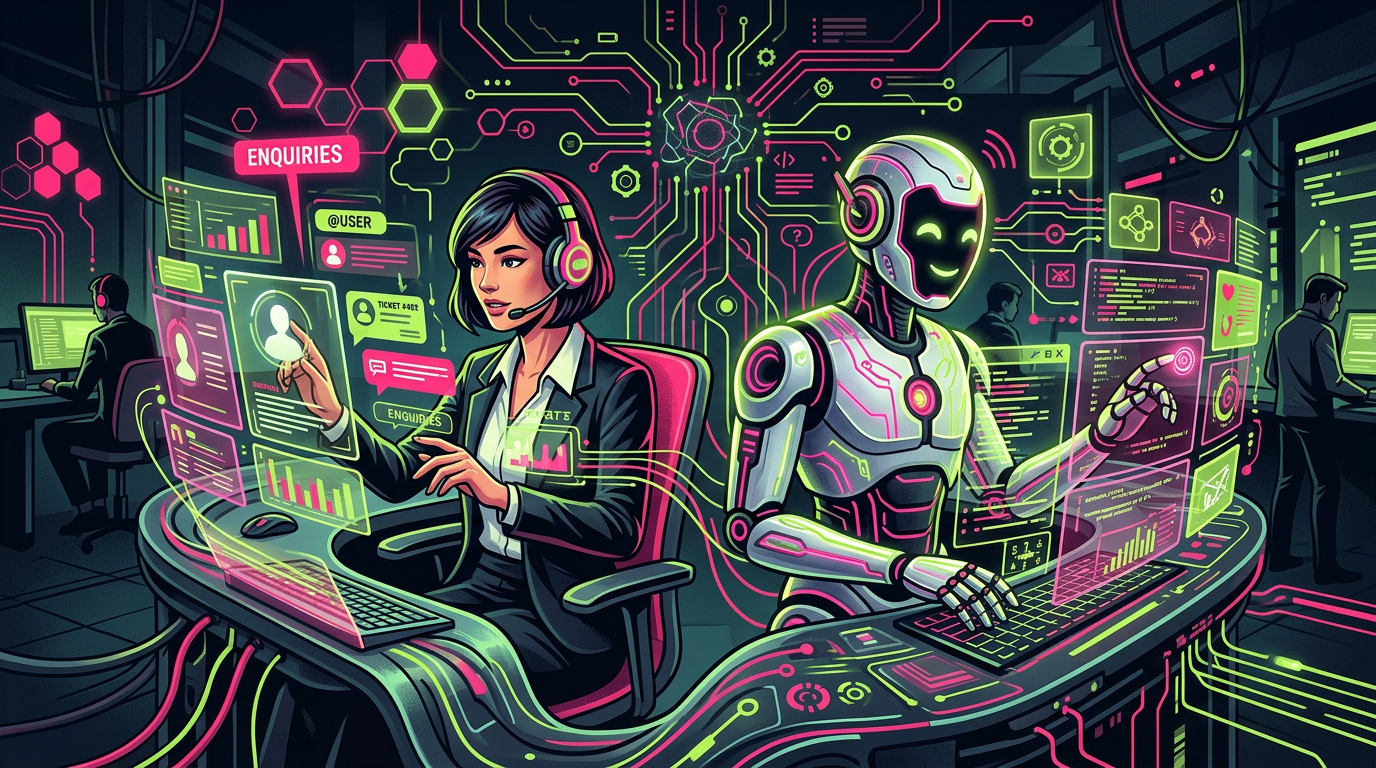
Short answer: Yes, AI can profoundly help your business automate customer service and support. By deploying AI-powered tools such as chatbots, virtual assistants, and sentiment analysis, companies can handle routine enquiries, provide instant responses 24/7, and offer personalised support, leading to increased efficiency and customer satisfaction.
Key takeaways
- AI-driven chatbots and virtual assistants handle up to 80% of routine customer queries, significantly reducing response times.
- AI automates repetitive tasks, freeing human agents to focus on complex, high-value interactions.
- Sentiment analysis and predictive analytics allow businesses to understand customer mood and anticipate needs, leading to proactive support.
- 24/7 availability of AI support systems improves customer satisfaction and expands service reach globally.
- Personalisation capabilities of AI enhance customer experience, making interactions more relevant and efficient.
- Businesses must strategically integrate AI with human oversight to maintain quality and handle edge cases effectively.
How does AI automate customer service?
AI automates customer service by leveraging sophisticated algorithms and machine learning to understand, process, and respond to customer queries without direct human intervention. The most prominent applications are chatbots and virtual assistants. These systems can interpret natural language, access vast knowledge bases, and provide accurate, immediate answers to frequently asked questions. For instance, a chatbot can guide a customer through a troubleshooting process for a common product issue or help them track an order, reducing the need for a human agent.
Beyond straightforward Q&A, AI also facilitates automation through intelligent routing. When a customer interaction begins, AI can analyse the nature of the query and the customer's history to direct them to the most appropriate human agent or department if escalation is necessary. This prevents customers from being bounced between staff and ensures they reach someone who can help efficiently. Moreover, AI can provide agents with real-time suggestions and information during a call or chat, empowering them to resolve issues faster and more effectively. This integration of AI with human workflows represents a hybrid approach that maximises both efficiency and service quality.
For businesses looking to optimise their online presence, understanding how AI processes information is crucial. Our article on NLP in AI: AEO Strategy for Business Visibility delves deeper into how Natural Language Processing underpins these automation capabilities, allowing AI to comprehend and generate human-like text.
What types of customer interactions can AI handle?
AI is increasingly capable of handling a wide spectrum of customer interactions, moving beyond simple FAQs. Primarily, it excels at high-volume, repetitive tasks. This includes answering common questions about products, services, or policies; providing order status updates; assisting with password resets; and even processing basic returns or exchanges. These transactions are typically rule-based and can be effectively managed by AI algorithms accessing structured data.
More advanced AI systems can engage in semi-complex dialogues, guiding users through decision trees or offering personalised recommendations based on past interactions or browsing history. For instance, an AI virtual assistant might help a customer select the right product by asking a series of qualifying questions, much like an in-store assistant. Predictive AI takes this a step further by analysing customer behaviour and historical data to anticipate needs or potential issues before the customer even contacts support. This proactive approach can involve sending automated reminders, offering preemptive solutions, or prompting engagement when a customer seems stuck.
| Interaction Type | AI Capability | Benefit for Business |
|---|---|---|
| General FAQs | Instant, accurate answers | Reduced agent workload, 24/7 support |
| Order Tracking/Updates | Automated information retrieval | Improved customer satisfaction, reduced wait times |
| Tier 1 Technical Support | Guided troubleshooting, knowledge base access | Faster resolution for common issues |
| Personalised Recommendations | Data analysis of preferences/history | Increased sales, enhanced customer experience |
| Sentiment Analysis | Detecting customer mood/frustration | Proactive intervention, improved service quality |
| Lead Qualification | Asking qualifying questions | Efficient routing to sales, reduced wasted effort |
To ensure your business's information is readily available for these AI interactions, consider how your data is structured. Our guide on Structured Data & Schema Markup in AEO provides essential insights into making your content AI-friendly.
What are the benefits of integrating AI into customer support?
Integrating AI into customer support offers a compelling array of benefits for businesses of all sizes. Firstly, it dramatically improves efficiency. AI-powered chatbots and virtual assistants can handle a large volume of concurrent queries, eliminating wait times and ensuring customers receive immediate assistance. This 24/7 availability means your business effectively has an always-on support team, catering to customers across different time zones without incurring overtime costs.
Secondly, AI leads to significant cost savings. By automating routine tasks, businesses can reduce the need for extensive human support staff, or reallocate existing staff to more complex, value-generating activities. A study by IBM found that chatbots can reduce customer service costs by 30%. This efficiency gain directly impacts the bottom line. Furthermore, AI's ability to quickly access information and guide customers to solutions often results in higher first-contact resolution rates, further reducing operational expenses associated with repeated contacts.
Lastly, AI enhances the overall customer experience. Personalisation, driven by AI analysing customer data, allows for tailored interactions. This makes customers feel understood and valued, leading to increased satisfaction and loyalty. AI can also identify patterns in customer queries, providing valuable insights that can inform product development, marketing strategies, and service improvements. For a deeper dive into improving customer experience using AI, read our article on AI Personalisation for Customer Experience: A Business Guide.
What are the challenges and considerations for AI customer service?
While the benefits are significant, implementing AI in customer service isn't without its challenges. One primary concern is maintaining a human touch. While AI excels at routine tasks, complex emotional, or highly nuanced issues often require human empathy and problem-solving. Over-reliance on AI can lead to customer frustration if they feel unheard or unable to reach a human when needed.
Another consideration is the initial setup and ongoing training of AI systems. Implementing an effective chatbot or virtual assistant requires significant investment in natural language processing (NLP) models, comprehensive knowledge bases, and continuous data feeding for improvement. The AI needs to learn from interactions, and this learning process requires careful monitoring and refinement to avoid inaccurate or unhelpful responses. Poorly trained AI can do more harm than good, damaging customer trust.
Ensuring your AI aligns with your brand voice and provides accurate, helpful information is paramount. This directly impacts how your brand is perceived by customers and, crucially, how AI answer engines might cite your business. For comprehensive guidance on preparing your business for the AI answer engine landscape, consult our full guide to AI for Business: Mastering Answer Engine Optimization (AEO).
Finally, data privacy and security are paramount. AI systems collect and process vast amounts of customer data. Businesses must ensure compliance with regulations like GDPR and maintain robust security measures to protect this sensitive information. A data breach involving an AI customer service system could have severe reputational and financial consequences. For detailed strategies on mitigating these risks, our article on AI Integration: Business Security Risks & Mitigation
What's the future of AI in enhancing human agents?
The future of AI in customer service isn't about replacing human agents entirely, but rather about enhancing their capabilities and allowing them to focus on higher-value work. AI is evolving to become a powerful co-pilot for human agents, providing them with real-time support and insights. During a customer interaction, AI can instantly pull up relevant customer history, product information, or troubleshooting guides, presenting it to the agent at the precise moment it's needed. This reduces the time agents spend searching for information, leading to quicker resolutions and more informed responses.
Beyond information retrieval, AI also assists with sentiment analysis. It can monitor the tone and sentiment of a customer's message or voice during a call, alerting the agent if the customer is becoming frustrated. This early warning system allows agents to adjust their approach, de-escalate situations, and provide more empathetic support. Furthermore, AI can automate post-interaction tasks such as summarising conversations, categorising issues, and updating CRM records, significantly reducing agent administrative burden. This allows human agents to dedicate more time to complex problem-solving, relationship building, and strategic customer engagement. For tools that help you audit your online presence for AI visibility, WebAppRocket.ai offers a suite of features to ensure your business is optimally positioned.
FAQs
How quickly can AI be implemented in customer service?
Implementation time varies greatly depending on the complexity of your needs. For basic FAQ chatbots, you could see results in a few weeks to months. More sophisticated virtual assistants requiring extensive integration with existing systems and custom NLP training might take 6 to 12 months, or even longer for enterprise-level deployments.
Is AI suitable for all types of businesses?
Yes, AI can benefit nearly any business that handles customer inquiries, regardless of size or industry. Small businesses can start with basic chatbots for common questions, while larger enterprises can implement comprehensive AI-driven contact centre solutions. The key is to identify specific pain points AI can address.
Will AI replace all customer service jobs?
No, not entirely. AI is highly effective at automating repetitive and data-driven tasks, but human agents remain crucial for complex, empathetic, and strategic interactions. AI is more likely to transform roles, allowing human agents to focus on higher-value problem-solving and relationship building.
How does AI ensure data privacy in customer interactions?
AI systems must be designed and operated with strict adherence to data privacy regulations (e.g., GDPR, CCPA). This involves anonymising data where possible, encrypting sensitive information, obtaining explicit consent for data usage, and implementing robust access controls. Regular security audits are essential.
What's the difference between a chatbot and a virtual assistant?
While often used interchangeably, a chatbot typically handles rule-based or script-driven conversations for specific tasks (e.g., order status). A virtual assistant is generally more advanced, capable of understanding more complex natural language, maintaining context across conversations, and performing a broader range of tasks, often integrating with multiple systems.
How can I measure the ROI of AI in customer service?
You can measure ROI through metrics like reduced average handle time, increased first-contact resolution rates, decreased support costs, improved customer satisfaction scores (CSAT/NPS), and a reduction in agent burnout. Track these metrics before and after AI implementation to assess its impact.
At InternetMonkeez, we specialise in helping businesses like yours navigate the complexities of AI integration for enhanced customer service and optimal answer engine visibility. Whether you're looking to implement chatbots or develop a comprehensive AEO strategy, our expert team is ready to provide practical, results-driven solutions. Contact us today to discuss your specific needs.