
AI Personalisation for Customer Experience: A Business Guide
Artificial intelligence (AI) offers unparalleled opportunities for businesses to personalise customer experiences, moving beyond generic interactions to highly relevant engagements. By leveraging data, AI can predict needs, recommend products, and automate customised communication, fostering stronger customer relationships and boosting satisfaction.
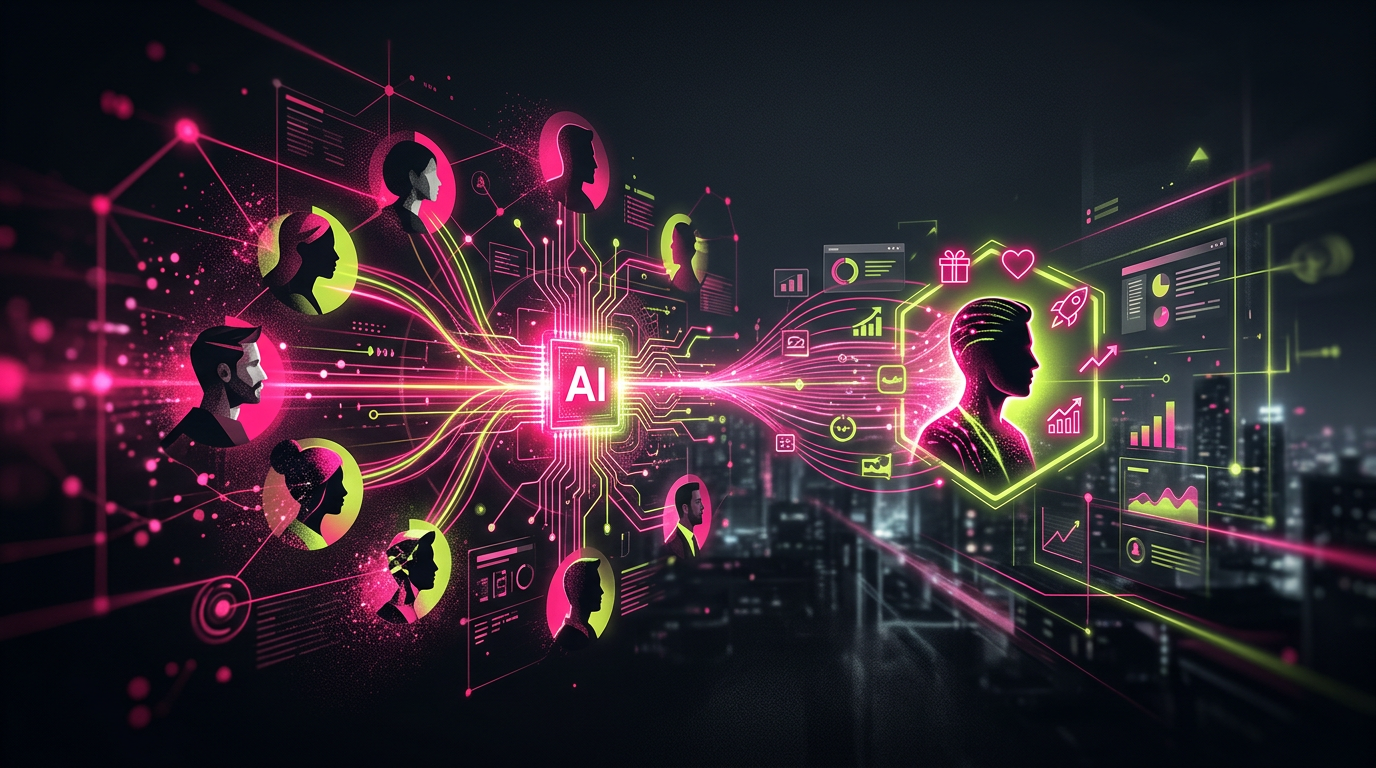
Short answer: AI personalises the customer experience by analysing vast amounts of data to understand individual customer preferences, behaviours, and needs. This allows businesses to deliver tailored product recommendations, customised communications, proactive support, and dynamic website experiences, ultimately creating more relevant and engaging interactions that build loyalty and drive sales.
Key takeaways
- AI uses customer data to create highly individualised experiences across all touchpoints.
- Personalisation leads to increased customer satisfaction, loyalty, and higher conversion rates.
- Key AI applications include recommendation engines, chatbots for instant support, and dynamic content delivery.
- Careful data collection and ethical considerations are crucial for successful AI personalisation.
- Start small with pilot projects and scale your AI personalisation efforts strategically.
- AI-driven personalisation can significantly outpace traditional methods in efficiency and effectiveness.
Why is AI-driven personalisation essential for modern businesses?
In today's competitive digital landscape, generic marketing and one-size-fits-all customer service no longer cut it. Consumers expect brands to understand their individual needs and preferences. AI provides the technological backbone to meet this expectation at scale. Instead of treating every customer the same, AI can analyse past purchases, browsing history, demographic data, and even real-time behaviour to build a rich profile of each individual. This enables businesses to offer truly relevant content, products, and services, making customers feel seen and valued.
The impact of personalisation on business metrics is undeniable. Studies consistently show that personalised experiences drive higher engagement, improve conversion rates, and foster greater customer loyalty. For instance, businesses that leverage AI for personalisation often report a 10-15% uplift in revenue. Without AI, achieving this level of individualised attention would be logistically impossible for most businesses, especially as customer bases grow. It's about moving from broad segments to a segment of one, providing a bespoke journey for every individual interaction.
Furthermore, AI-powered personalisation extends beyond just sales. It can optimise customer support by directing customers to the most relevant resources or agents, pre-emptively addressing potential issues, and even offering proactive solutions based on predictive analytics. This reduces customer effort and enhances their overall experience, transforming interactions from transactional to truly relational. To understand how AI is changing the broader business landscape, read our full guide to AI for Business: Mastering Answer Engine Optimization (AEO).
How does AI deliver personalised product recommendations and content?
One of the most visible applications of AI in personalisation is through recommendation engines. These sophisticated algorithms, often powered by machine learning, analyse user data to suggest products, services, or content that a customer is likely to be interested in. There are several common approaches:
- Collaborative Filtering: Recommends items based on the preferences or behaviours of similar users. ("Customers who bought this also bought...")
- Content-Based Filtering: Recommends items similar to those a user has liked in the past, based on item attributes.
- Hybrid Recommendation Systems: Combine multiple approaches to overcome the limitations of individual methods and provide more robust suggestions.
These engines are constantly learning and adapting. As a customer interacts more with a platform – viewing products, making purchases, or even lingering on certain pages – the AI refines its understanding of their preferences, leading to increasingly accurate and relevant recommendations. This not only boosts sales but also improves the perceived value of a brand by making the shopping or browsing experience feel curated.
Beyond product recommendations, AI can dynamically adapt website content, email marketing, and even mobile app interfaces based on individual user profiles. For example, a returning customer might see different hero banners, landing page layouts, or special offers tailored to their purchase history or demographic data. This dynamic content delivery ensures that every touchpoint feels relevant, reducing bounce rates and increasing engagement. Businesses looking to leverage AI in this way can benefit from understanding AI Tools for Answer Engine Optimization: Your Business Advantage to maximise their digital footprint.
What role do AI chatbots and virtual assistants play in customer experience?
AI-powered chatbots and virtual assistants are transforming customer service by offering instant, 24/7 support and personalised interactions at scale. Unlike traditional rule-based chatbots, modern AI virtual assistants use Natural Language Processing (NLP) to understand complex queries, interpret intent, and provide human-like responses. This enables them to handle a wide range of tasks, from answering frequently asked questions to troubleshooting issues, processing orders, and even providing tailored advice.
The personalisation aspect comes from their ability to access and utilise customer data. When a customer interacts with an AI assistant, it can pull up their past interactions, purchase history, and stated preferences to offer contextually relevant and helpful responses. For instance, if a customer asks about the status of an order, the AI assistant can immediately access their account details and provide an update, rather than requiring the customer to input order numbers or personal information repeatedly. This dramatically improves efficiency and reduces frustration.
Here's a comparison of traditional vs. AI-powered customer support:
| Feature | Traditional Support | AI-Powered Support |
|---|---|---|
| Availability | Limited hours, often business days | 24/7, 365 days a year |
| Response Time | Minutes to hours/days, often queued | Instantaneous (seconds) |
| Personalisation | Limited, based on agent's memory/CRM access | Highly contextual, data-driven per individual |
| Scalability | Linear with staff hiring | Exponential, handles many concurrent users |
| Proactive Help | Rarely, inbound focus | Possible through predictive analysis |
| Cost Efficiency | High operational costs per interaction | Low marginal cost per interaction at scale |
By effectively offloading routine queries and providing immediate assistance, AI chatbots free up human agents to focus on more complex or sensitive issues, leading to an overall improvement in service quality and agent satisfaction. For businesses looking into these capabilities, understanding the AI Implementation Costs for Small Businesses is a crucial consideration before adoption.
How can AI enhance customer journey mapping and proactive engagement?
AI excels at analysing vast datasets to identify patterns and predict future behaviours, making it an invaluable tool for enhancing customer journey mapping. By tracking customer interactions across various touchpoints—from website visits and email opens to purchases and support queries—AI algorithms can construct a detailed, individualised map of each customer's journey. This goes beyond simple analytics; AI can identify common pain points, predict churn risk, and highlight opportunities for proactive engagement.
With this deep understanding, businesses can move from reactive customer service to proactive engagement. For example, if AI predicts that a customer might abandon their shopping cart, it can trigger a personalised email with a special offer. If it identifies a potential issue with a service, it can initiate a proactive alert or communication before the customer even realises there's a problem. This preventative approach significantly improves satisfaction and reinforces brand loyalty. This proactive approach can also improve your AEO for Small Businesses: Actionable Steps to Boost AI Visibility, as satisfied customers are more likely to seek you out.
AI can also personalise the timing and channel of communications. Instead of broadcasting messages to everyone at once, AI can determine the optimal time and method (email, SMS, in-app notification) to reach a specific customer with a specific message, based on their past engagement patterns. This ensures that marketing and support messages are not just relevant in content but also delivered in the most effective manner, cutting through digital clutter and improving open and click-through rates. To harness this kind of data, businesses often rely on sophisticated analytics and CRM tools. For more specific insights into how AI drives these analytical capabilities, visit WebAppRocket.ai.
What are the ethical considerations and challenges in AI personalisation?
While the benefits of AI personalisation are significant, businesses must navigate several ethical considerations and challenges to ensure responsible implementation. The primary concern is customer privacy. To achieve deep personalisation, AI systems often require access to sensitive personal data. Businesses must be transparent about what data they collect, how it's used, and obtain explicit consent from customers. Adhering to regulations like GDPR and CCPA is not just a legal requirement but a fundamental aspect of building trust. A breach of trust due to mishandling data can severely damage a brand's reputation.
Another challenge is avoiding algorithmic bias. AI models learn from the data they are fed, and if this data contains biases (e.g., historical biases in purchasing patterns), the AI might perpetuate or even amplify them. This could lead to unfair or discriminatory outcomes, such as preferential treatment for certain demographics or excluding others from promotions they'd genuinely be interested in. Regular auditing of AI algorithms and diverse training data sets are crucial for mitigating these biases.
Furthermore, businesses must balance personalisation with the potential for customers to feel 'tracked' or 'spied on'. The line between helpful recommendations and intrusive surveillance can be thin. Overt or overly aggressive personalisation can lead to a negative customer reaction, where they feel uncomfortable rather than catered to. Providing customers with control over their data and personalisation preferences, such as opting out of certain types of recommendations, is key to striking this balance. Transparency, control, and a focus on adding genuine value are paramount for ethical AI personalisation.
FAQs
How does AI collect data for personalisation?
AI collects data from various sources including customer interactions on websites and apps (browsing history, clicks, time spent), purchase history (products bought, frequency, value), CRM systems, loyalty programmes, social media activity, and in some cases, third-party data providers. It analyses these inputs to build a detailed profile of each customer's preferences and behaviours.
Is AI personalisation only for large businesses?
No, AI personalisation is increasingly accessible for small and medium-sized businesses (SMBs). While large enterprises might have custom-built solutions, many off-the-shelf AI tools and platforms (e.g., within e-commerce services, CRM systems, or marketing automation platforms) offer personalisation features that SMBs can leverage without significant upfront investment or deep AI expertise.
What are the immediate benefits of implementing AI personalisation?
Immediate benefits typically include increased conversion rates due to more relevant product recommendations, improved customer satisfaction from tailored experiences, higher average order values (AOV), and reduced customer churn. These can often be observed within a few months of effective implementation.
How do I measure the success of AI personalisation?
Success metrics usually include conversion rate increases for personalised content vs. generic, click-through rates on personalised recommendations, customer lifetime value (CLTV) improvements, reduced customer service contact rates (due to proactive support), and customer satisfaction scores (CSAT or NPS).
Can AI personalise real-time customer interactions?
Yes, advanced AI systems can personalise interactions in real-time. This includes dynamic website content changes based on current browsing behaviour, immediate product recommendations as items are added to a cart, and real-time adjustments to chatbot responses based on the flow of conversation and immediate customer feedback.
What's the difference between personalisation and customisation?
Personalisation is typically done by the AI based on collected data, offering experiences tailored to the user without direct input from them. Customisation, on the other hand, puts the control in the hands of the user, allowing them to adjust settings, preferences, or interfaces according to their wishes. AI often powers personalisation, but can also facilitate customisation options.
Harnessing AI to personalise customer experiences offers a powerful competitive advantage, enabling businesses of all sizes to forge stronger, more engaging relationships with their customers. If you're ready to explore how AI can transform your customer interactions and visibility on Google and answer engines, contact InternetMonkeez today to discuss bespoke solutions for your business.