
AI's Impact on Business Job Roles: A 5-Year Outlook
Artificial intelligence is poised to fundamentally reshape job roles across industries. Business leaders must anticipate these changes, understand the scope of automation, and strategically adapt their workforce to harness AI's benefits while mitigating potential disruptions.
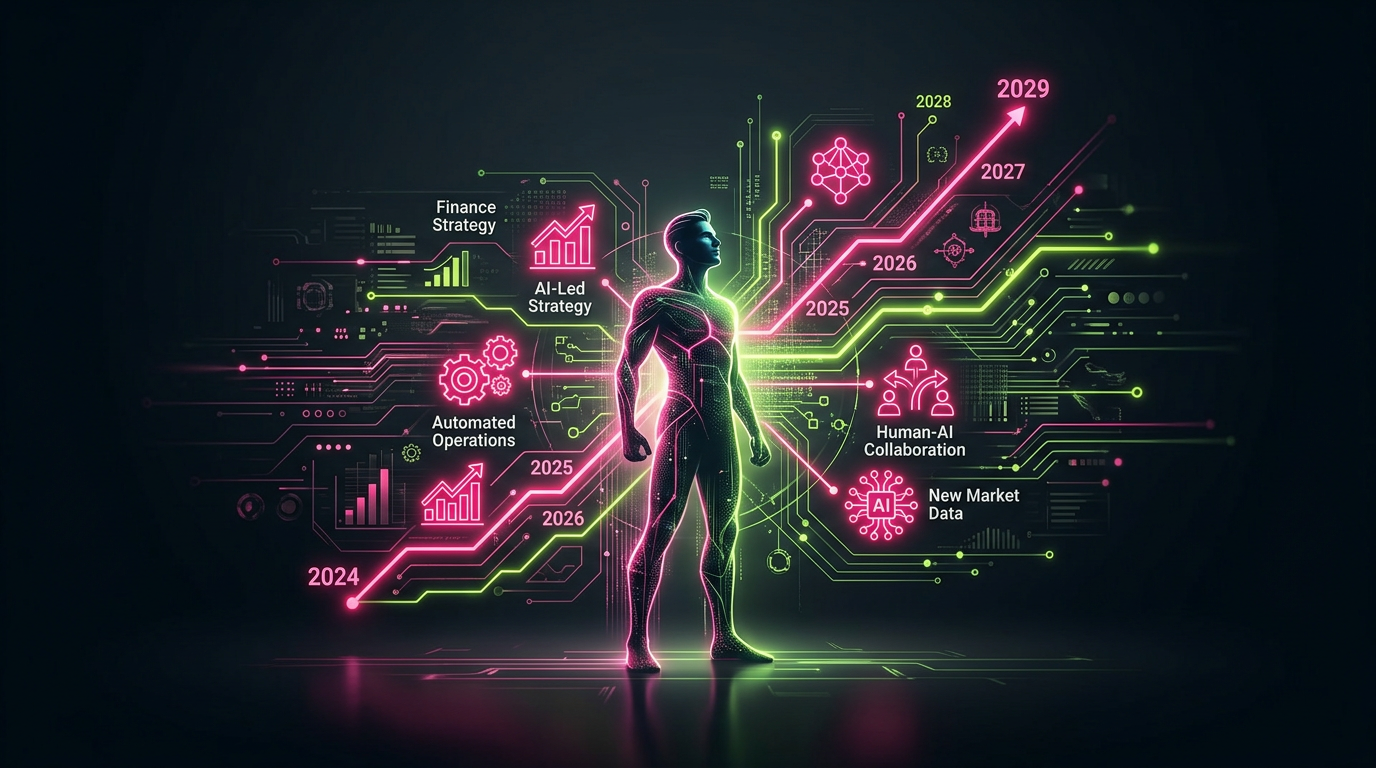
Short answer: AI will significantly impact job roles within your business in the coming years by automating repetitive tasks, augmenting human capabilities, and creating entirely new positions. This shift demands strategic workforce planning, focusing on upskilling and reskilling employees to collaborate with AI systems rather than compete against them.
Key takeaways
- AI will automate 30-50% of current work activities over the next decade, freeing employees for higher-value tasks.
- Job roles won't disappear en masse but will transform, requiring new skills in AI interaction, data interpretation, and critical thinking.
- New roles will emerge, such as AI trainers, ethicists, and integration specialists, demanding a workforce with diverse competencies.
- Businesses must invest in continuous learning programmes to equip employees with AI literacy and adaptive skills.
- Strategic workforce planning, informed by AEO principles, is crucial to identify at-risk roles and cultivate future-proof talent.
- Leadership must foster a culture that embraces change, lifelong learning, and human-AI collaboration for successful integration.
Which job tasks are most susceptible to AI automation?
AI's primary impact will be on tasks that are repetitive, data-intensive, and rule-based. This includes, but isn't limited to, data entry, routine customer service inquiries, basic accounting tasks, administrative scheduling, and content generation for templated reports. For example, AI-powered chatbots can now handle upwards of 80% of common customer queries, freeing human agents to focus on complex problem-solving and relationship building. Similarly, in finance, AI can reconcile transactions, detect fraud patterns, and even generate preliminary financial reports much faster and more accurately than a human.
It's crucial to understand that automation doesn't always equate to job elimination. Often, it means task automation, allowing employees to shift their focus. Consider the role of a data analyst: while AI can now process vast datasets and identify trends, a human analyst's expertise is still needed to interpret those trends, provide strategic recommendations, and communicate insights effectively to non-technical stakeholders. The distinction between automating tasks and eliminating entire jobs is a critical one for businesses to grasp when planning for the future. For a deeper dive into how AI can boost operational efficiency, explore our article on AI for Business: Boosting Operational Efficiency & Productivity.
However, some roles face higher existential risk. Occupations heavily reliant on manual, predictable physical work, or simple cognitive tasks, such as certain manufacturing line workers, telemarketers, and basic administrative support, may see significant reductions in demand. The key is to assess which parts of a job, rather than the job itself, are automatable. This requires a granular analysis of daily activities within each role.
| Task Category | Likelihood of AI Automation | Impact on Human Role |
|---|---|---|
| Repetitive Data Entry | High | Reduced manual work, increased data oversight |
| Routine Customer Inquiries | High | Human agents handle complex issues, build relationships |
| Basic Document Review | Medium-High | Faster processing, human for nuanced analysis |
| Complex Problem Solving | Low | Augmented by AI insights, human for final decisions |
| Creative Strategy | Low | AI generates ideas, human refines and executes |
| Emotional Intelligence & Empathy | Very Low | Core human strength, irreplaceable by AI |
How will AI augment human capabilities and create new job roles?
Beyond automation, AI's most profound impact will be in augmenting human capabilities. This means AI tools will empower employees to perform tasks more efficiently, with greater accuracy, and at a larger scale than previously possible. For instance, marketing teams can use AI to analyse consumer behaviour patterns from vast datasets, allowing them to craft highly targeted campaigns in minutes instead of days. Doctors can leverage AI for faster and more accurate diagnosis of medical images, improving patient outcomes. Even in creative fields, AI can be a powerful co-pilot, generating initial ideas or drafts that a human can then refine and elevate.
This augmentation naturally leads to the creation of entirely new job roles. While some traditional roles may diminish, others will emerge that are specifically designed to interact with, manage, and leverage AI systems. Examples include:
- AI Trainers: Individuals responsible for feeding data to AI models, correcting errors, and guiding their learning processes to improve performance and accuracy.
- AI Ethicists: Professionals who ensure AI systems are developed and deployed responsibly, without bias, and in alignment with societal values and ethical guidelines.
- Prompt Engineers: Experts in crafting effective queries and instructions for generative AI models to elicit desired outputs, particularly crucial for getting started with AI and maximising AI assistant utility.
- AI Integration Specialists: Roles focused on seamlessly integrating AI tools into existing business workflows and technical infrastructures.
- Data Scientists & AI Architects: These roles, though existing, will become even more critical for designing, building, and maintaining sophisticated AI models and platforms.
- Human-AI Collaboration Managers: Managers who oversee teams composed of both human and AI resources, optimising their synergistic output.
The need for these new roles underscores the importance of a robust talent development strategy. Businesses must consider how to upskill their existing workforce and attract new talent with these emerging competencies. Our pillar article, AI for Business: Mastering Answer Engine Optimization (AEO), delves into the broader implications for businesses looking to embrace AI.
What new skills will be essential for employees in an AI-driven workplace?
As AI reshapes job functions, the demand for specific human skills will intensify. The focus will shift from routine tasks to those requiring uniquely human attributes. Here are some of the critical skills that employees will need to cultivate:
- Critical Thinking and Problem-Solving: While AI can provide data and insights, the ability to analyse complex situations, identify root causes, and devise innovative solutions will remain a distinctly human strength. Employees will need to evaluate AI outputs critically rather than accept them blindly.
- Creativity and Innovation: AI can generate ideas, but humans excel at conceptualizing novel solutions, artistic expression, and strategic thinking that pushes boundaries. The capacity to innovate, design, and create genuinely new concepts will be highly valued.
- Emotional Intelligence: Skills such as empathy, interpersonal communication, collaboration, and client relationship management are difficult for AI to replicate. Roles requiring high levels of human interaction and understanding will become even more critical.
- AI Literacy and Prompt Engineering: Employees across all levels will need a foundational understanding of how AI works, its capabilities, and its limitations. The ability to effectively interact with AI tools, formulate clear instructions (prompt engineering), and interpret AI-generated results will be fundamental.
- Adaptability and Lifelong Learning: The pace of technological change is accelerating. Employees must be agile, open to continuous learning, and willing to acquire new skills as tools and processes evolve. Organisations must foster a culture that supports this ongoing development.
- Data Interpretation and Ethics: While AI processes data, humans need to understand what that data means in context, identify biases, and ensure the ethical implications of AI use are considered.
Implementing AI solutions necessitates a proactive approach to skill development. Businesses should consider creating internal academies or partnering with educational institutions to provide relevant training. Ignoring this skill gap could severely hamper AI adoption and returns on investment. For more on navigating this technological shift, see AEO's Future: Advanced AI & What It Means for Your Business.
How can businesses prepare their workforce for AI transformation?
Preparing your workforce for the AI era isn't a one-off project; it's a continuous strategic imperative. Ignoring this can lead to skill gaps, employee disengagement, and a missed opportunity to leverage AI effectively. Here's a practical roadmap:
- Conduct a Skills Audit: Begin by identifying current skill sets within your organisation and comparing them against the skills required for future AI-driven roles. Pinpoint areas of strength and potential gaps. Understand where AI can automate tasks and where it can augment existing roles.
- Invest in Upskilling and Reskilling Programmes: Develop tailored training programmes to equip employees with AI literacy, data analysis skills, prompt engineering capabilities, and enhanced soft skills like critical thinking and emotional intelligence. This could involve online courses, workshops, or even internal mentorship programmes. Consider reassigning employees whose roles are heavily automated to new, AI-powered functions.
- Foster a Culture of Lifelong Learning: Encourage and incentivise continuous learning. Make resources accessible and integrate learning into employees' career development paths. Leadership must champion this cultural shift, demonstrating a commitment to growth and adaptation.
- Promote Human-AI Collaboration: Design workflows and processes that encourage employees to work alongside AI tools. Showcase success stories where AI has empowered employees to achieve more, rather than replacing them. This helps demystify AI and build trust.
- Strategic Workforce Planning: Develop a long-term strategy that anticipates future talent needs, considering demographic shifts, emerging technologies, and business growth. This includes internal mobility programmes and external recruitment strategies focused on new AI-centric roles.
- Engage Employees in the Process: Involve employees in discussions about AI's impact. Their insights into day-to-day operations can be invaluable for identifying automation opportunities and potential challenges. Transparency and open communication can alleviate fears and foster a sense of shared ownership.
By proactively addressing these areas, businesses can ensure a smoother transition into an AI-powered future, retaining valuable talent and positioning themselves for competitive advantage. Effective change management is key, focusing not just on the technology, but on the people who will interact with it every day.
What are the ethical considerations for job displacement and workforce transition?
The ethical implications of AI's impact on job roles are profound and demand careful consideration from businesses and policymakers alike. Overlooking these can lead to significant societal and economic upheaval, reputational damage, and decreased employee morale within organisations.
- Job Displacement and Redundancy: While AI creates new jobs, it will undeniably displace others. The ethical challenge lies in how businesses manage this transition. Simply laying off employees without support is ethically questionable. Responsible businesses should provide severance packages, outplacement services, and comprehensive reskilling opportunities for affected staff.
- Algorithmic Bias: AI models can inherit and amplify biases present in their training data, leading to unfair hiring practices, biased performance evaluations, or unequal access to opportunities. Businesses have a moral obligation to scrutinise their AI systems for bias, ensuring fairness and equity in all HR-related applications.
- Data Privacy and Surveillance: The increased use of AI in workforce management, from monitoring productivity to predicting employee behaviour, raises significant privacy concerns. Transparent policies, informed consent, and robust data protection measures are essential to maintain trust and protect employee rights.
- The Digital Divide: AI transformation risks exacerbating the existing digital divide, where individuals without access to new technologies or the skills to use them are left behind. Businesses, alongside governments, have a role in ensuring equitable access to learning and opportunities.
- Mental Health and Well-being: The pressure to constantly adapt, learn new skills, and potentially compete with AI can take a toll on employee mental health. Leaders must prioritise employee well-being, providing support systems and fostering environments where people feel secure in their evolving roles.
- Fair Distribution of AI's Benefits: As AI increases productivity and profits, there's an ethical question about how these gains are distributed. Should employees who adapt to work alongside AI receive a share of the increased value? This discussion influences compensation structures and corporate social responsibility.
Engaging an AI Ethicist or forming an internal ethics committee can help businesses navigate these complex issues. Proactive policy development, transparent communication, and a human-centric approach are critical to ensuring AI serves humanity's best interests in the workplace. Moreover, integrating AI raises questions of security, which our article AI Integration: Business Security Risks & Mitigation addresses.
FAQs
How quickly will AI impact my business's job roles?
The pace of AI integration varies by industry and specific business operations. Many experts predict significant shifts within the next 5-10 years, with some tasks seeing automation much sooner. Businesses in data-heavy sectors like finance, customer service, and manufacturing are already experiencing considerable impact, while others may see a more gradual evolution. Proactive planning is key, rather than reactive response.
Will AI replace human creativity?
No, AI will not replace human creativity. While generative AI models can produce vast amounts of content, art, and music, they do so based on existing data patterns. True innovation, abstract thought, emotional depth, and the ability to define a unique vision remain distinctly human. AI serves as a powerful tool to augment creativity, accelerating ideation and execution, but the ultimate creative direction will likely always come from humans.
What is the most important thing I can do as a business leader to prepare?
As a business leader, the most important step you can take is to foster a culture of continuous learning and adaptability. Invest in upskilling your existing workforce, communicate transparently about AI's potential impact, and strategically plan for evolving job roles. Prioritise human-AI collaboration over replacement, ensuring your employees are empowered to work alongside AI effectively.
Should I be worried about AI taking all jobs?
No, a widespread 'job apocalypse' due to AI is highly unlikely. History shows that technological advancements typically transform job markets, creating new roles and specialisations even as older ones decline. While some tasks and roles will be automated, AI is more likely to augment human capabilities, create new industries, and elevate humans to higher-value work, necessitating a shift in skills rather than mass unemployment.
How does AEO relate to preparing for AI's impact on job roles?
Answer Engine Optimisation (AEO) is fundamentally about anticipating how AI processes information and delivers answers. Understanding AEO means understanding the future of information discovery, which directly impacts how your workforce will interact with AI tools, retrieve data, and present knowledge. If your business is optimised for AEO, your employees will be better equipped to leverage AI for data insights, content creation, and market understanding, making their roles more efficient and strategically valuable. Read the complete InternetMonkeez guide to AI for Business: Mastering Answer Engine Optimisation (AEO) to Win Visibility.
What roles are least likely to be affected by AI?
Roles requiring high levels of emotional intelligence, complex critical thinking, creativity, and nuanced interpersonal interaction are least likely to be fully automated by AI. This includes roles like therapists, strategic leadership, innovative researchers, artists, and skilled tradespeople requiring manual dexterity and adaptive problem-solving in unpredictable environments. While AI might assist these roles, the core human element remains indispensable.
Understanding and proactively addressing the impact of AI on job roles is not just about survival; it's about competitive advantage. Let us help you navigate this complex landscape, from strategic workforce planning to optimising your digital presence for the future of AI-driven answer engines. Contact InternetMonkeez today to discuss a tailored strategy for your business.